Your agents provision. Archie governs. You ship.
A whole platform team's output, from one person who owns the rules. Your platform engineer defines the golden paths and your developers ask for infrastructure, both from their own AI agent: Claude, Cursor, any MCP client. Archie composes, verifies, deploys and operates it inside your own cloud. The agent never holds the keys.
No Terraform. No fifty-variable forms. No ten-tool stack to assemble. A request goes in; a governed golden path comes out.
You already have a platform. Nobody designed it.
It accumulated over time — no one built it, no one owns it, and it shows.
Every deploy is manual.
Or it waits on the one person who actually knows the setup.
Security gaps hide until audit.
Public buckets, missing encryption, broad IAM — surfaced by the auditor, not before.
No golden path. No owner.
It accumulated, it wasn't built — and nobody has the time to govern it.
The big orgs solved this with a platform team. You need one person to own the rules — Archie holds them, and does the rest.
One person owns the rules — Archie is the platform team you didn't have to hire.
Archie gives your agents the same governed golden paths to consume and extend — inside your existing standards.
One path, end to end.
A platform engineer composes a golden path once; developers consume it forever. Both just ask — Archie does everything between the sentence and the running infrastructure, on rails.
Ask. Archie composes the golden path.
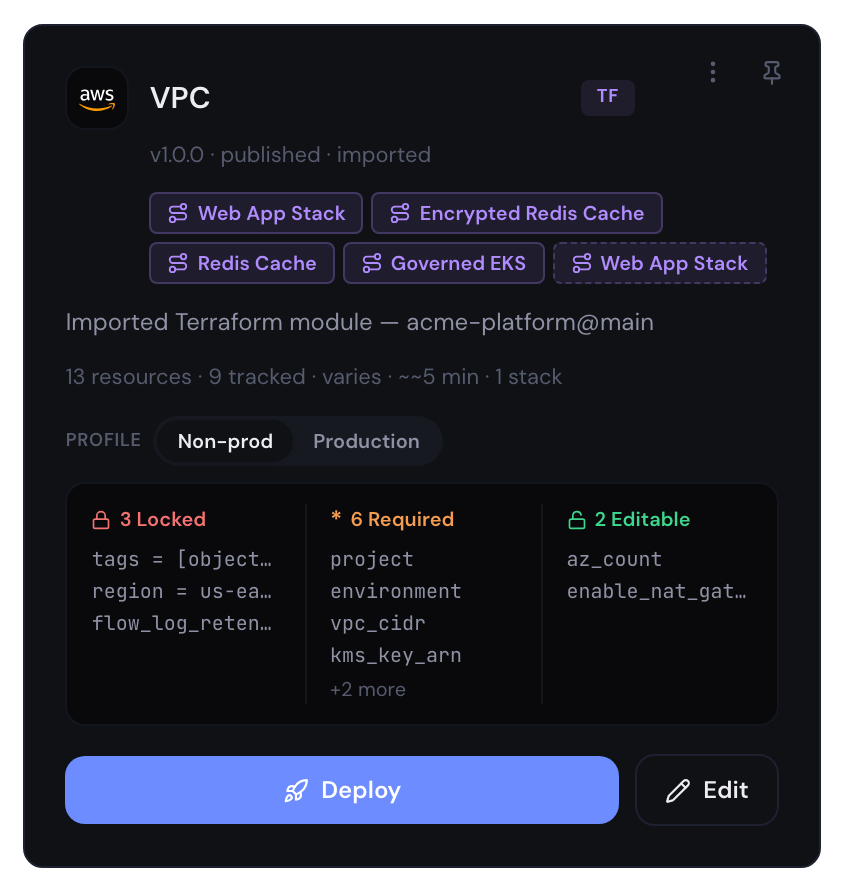
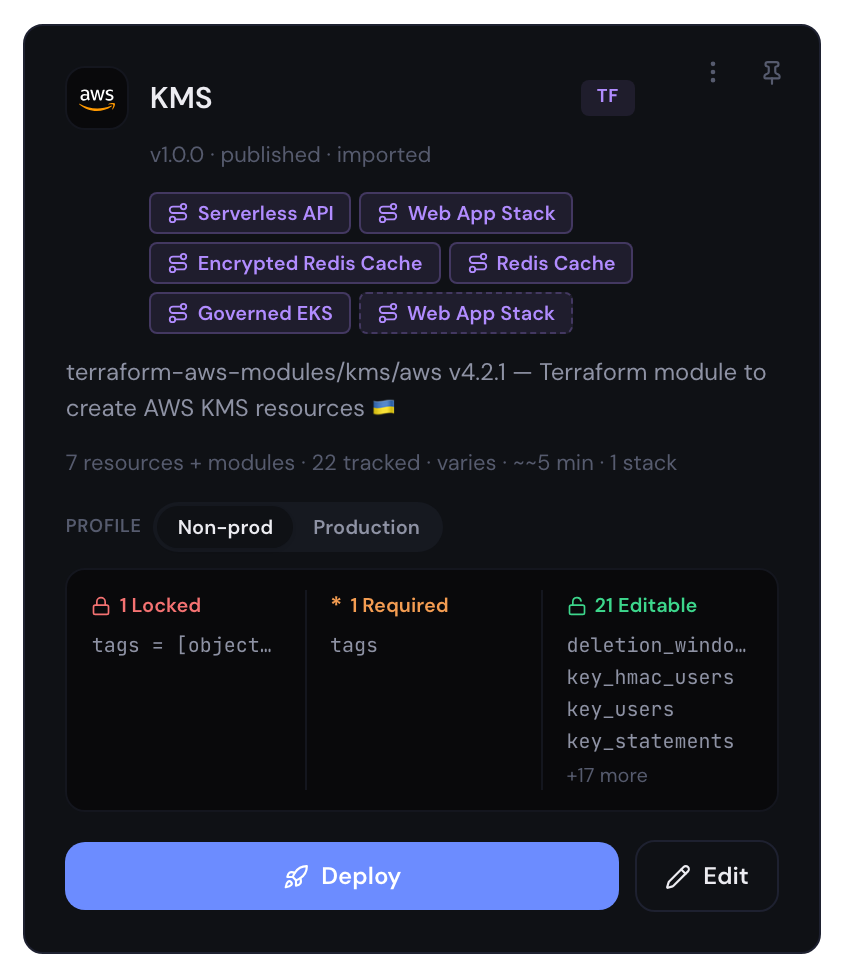
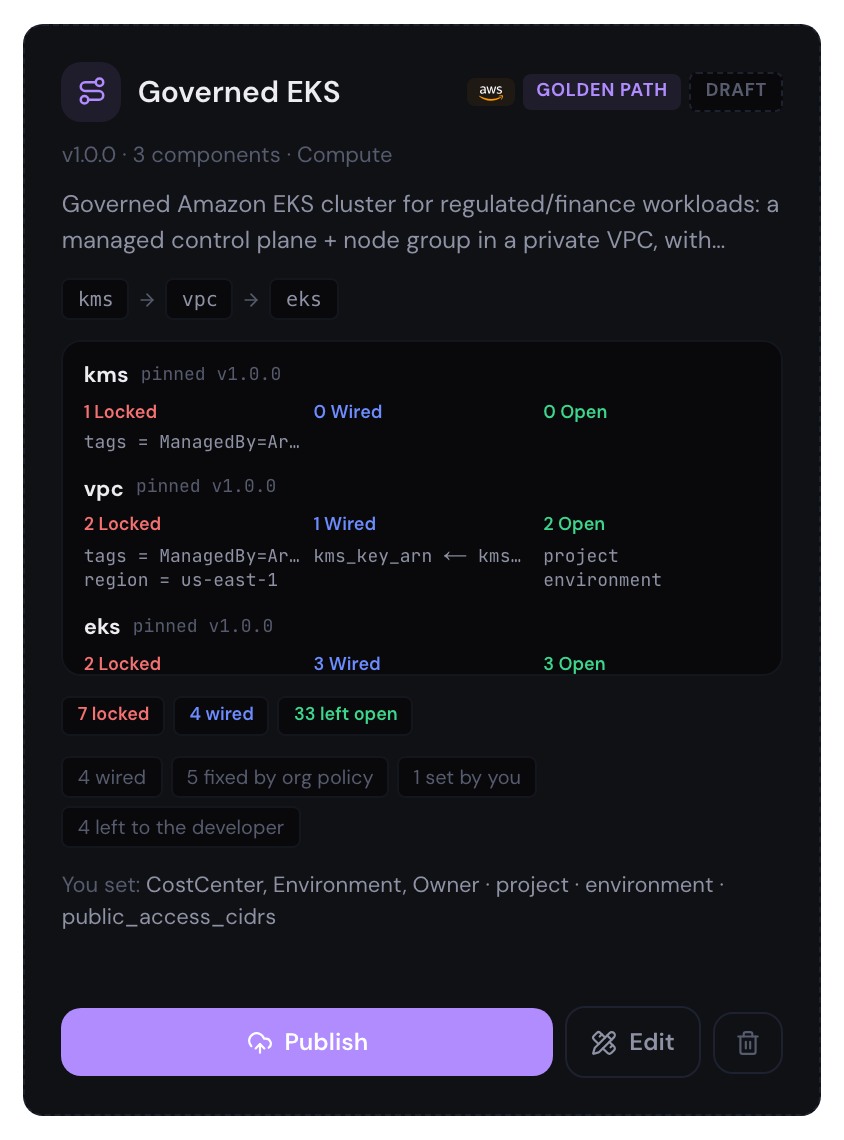
A platform engineer describes what they need in their own agent — Claude, Cursor, Antigravity. Archie reuses what you already have before it writes anything new, applies your org standards, and composes one golden path.
vpc and eks imported from your repo.kms — the one registry module — added.vpc_id, subnet_ids, kms_key_arn — 0 unmet dependencies. Draft saved · 4 fields left open for the deployer.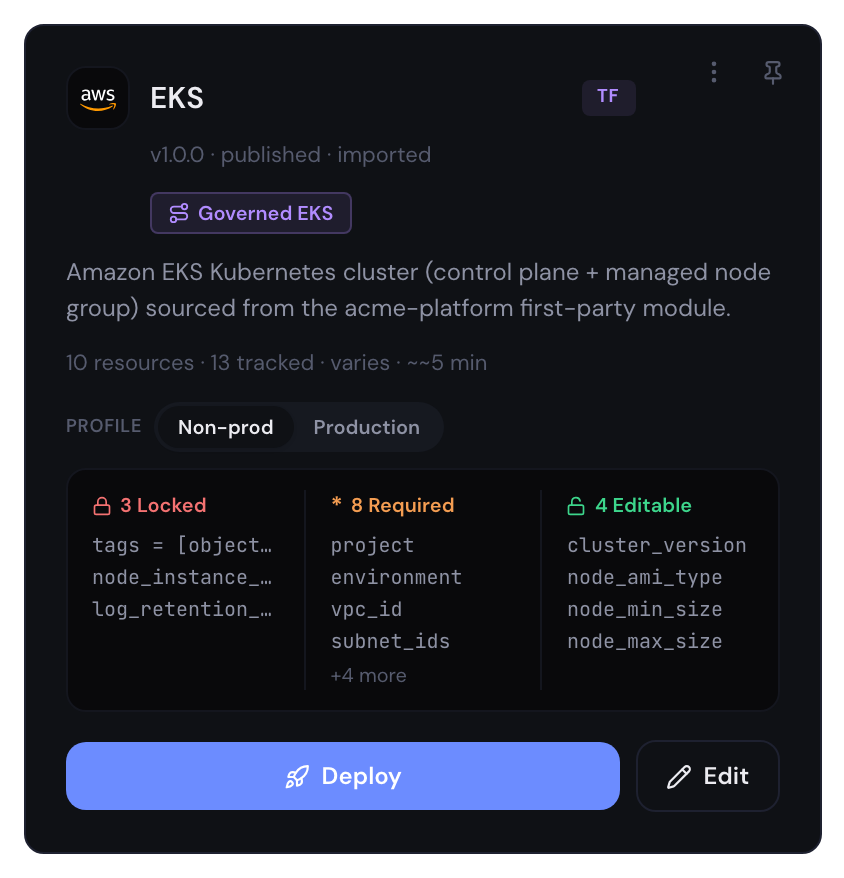
Checked before anything is built.
Archie checks the structure, then runs a plan pre-check that flags valid Terraform that would still fail once it runs. Nothing is created in your cloud at this step; it's the plan, read properly. The fields that must never change are locked, enforced server-side.
aws_eks_node_group has no egress, so nodes can't reach the control plane or pull from ECR. they never join the cluster — you'd wait for a timeout. flagged.vpc_id, subnet_ids, kms_key_arn were placeholders — a plan can't check an id it was handed. Composed, they resolve for real.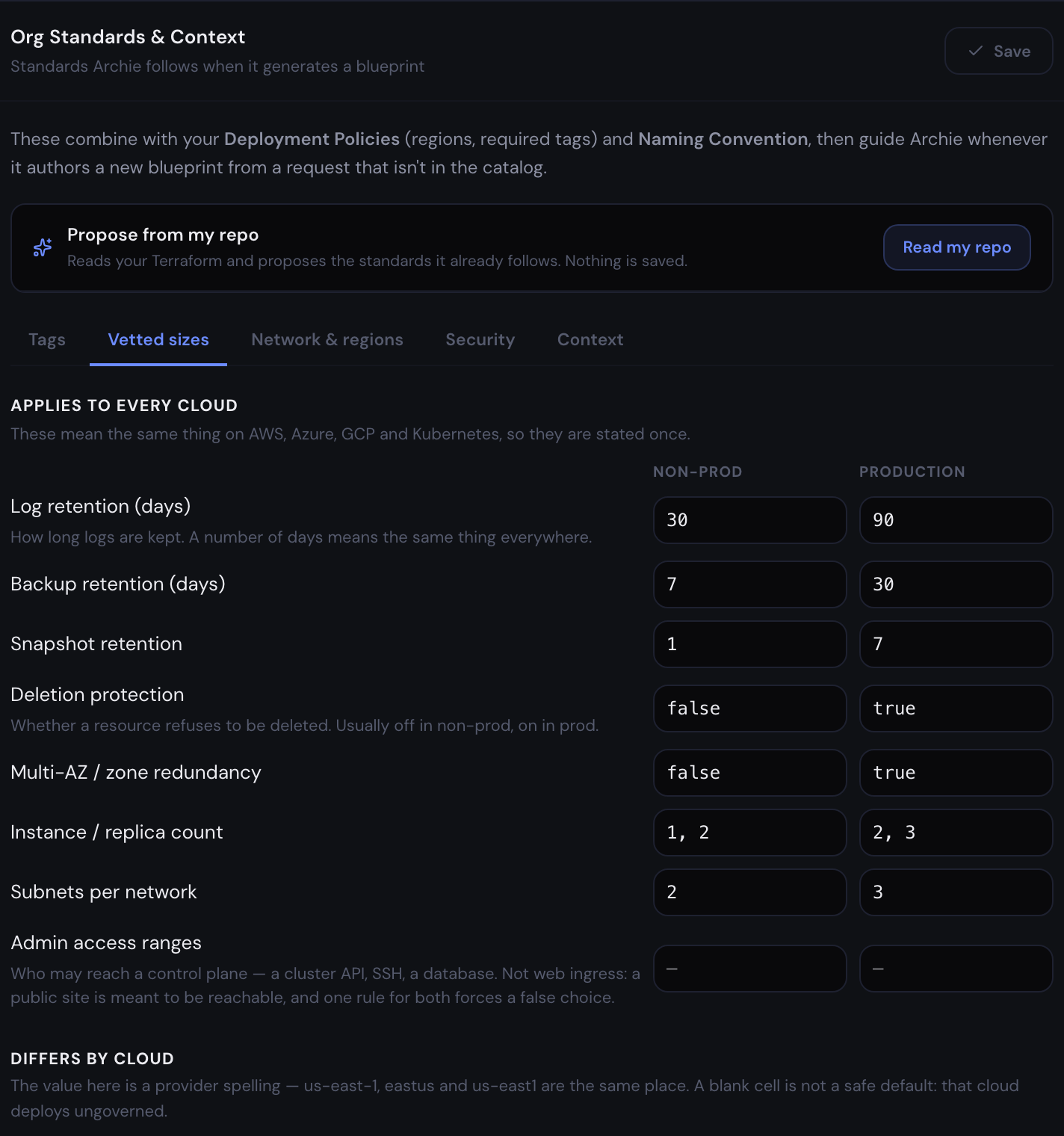
Governance fires on what the modules create — encryption is enforced because the resource stores data, not because someone remembered.
Proving it is what puts it in front of developers.
A path that would not run is refused outright — publishing mints trust, and a valid plan that still fails never reaches the catalog. One that will run publishes instantly, and then earns its place: Archie stands it up for real in your own non-production account, asserts it works, and tears it down. Only then does it appear on the developer menu. A platform engineer can put it there unproven — deliberately, with their name on it.
kms → vpc → eks for real · 2 AZs, no NAT, t3.small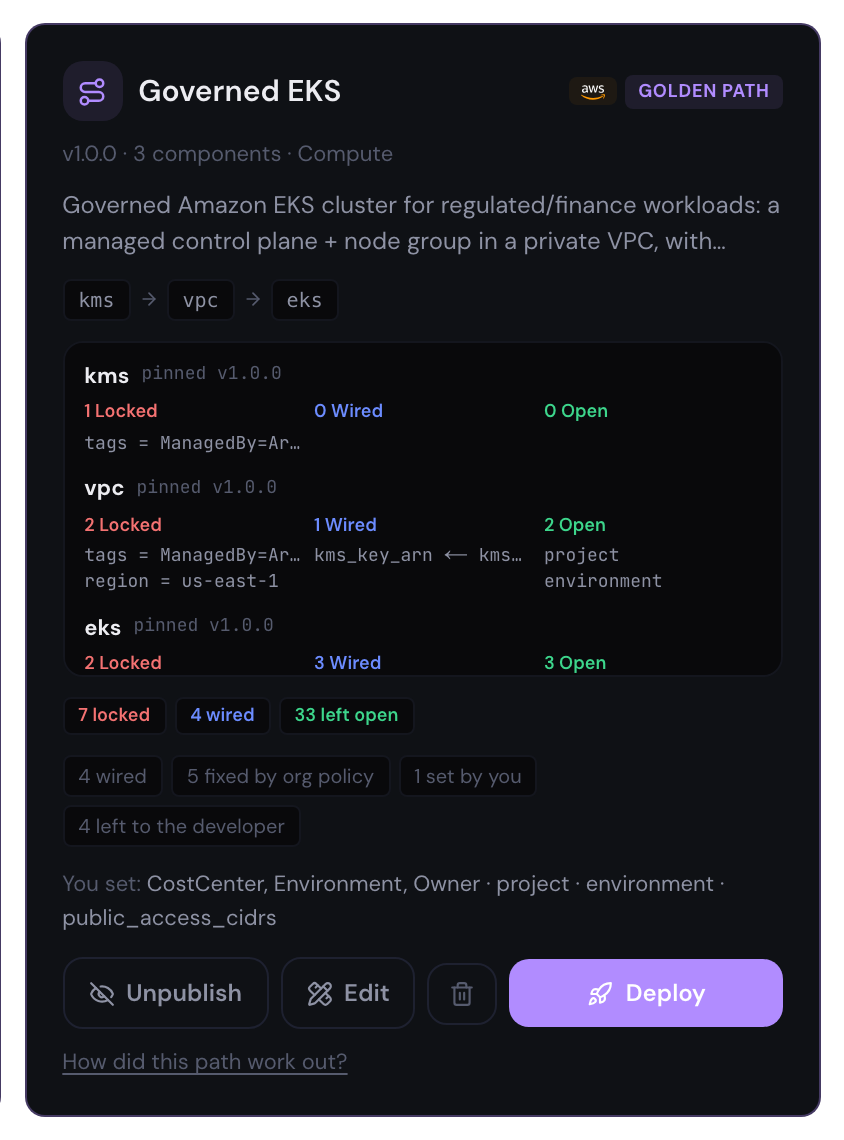
A developer self-serves. For real.
“I need a Kubernetes cluster for the payments service.” They ask their own agent and Archie picks Governed EKS off the catalog — the path the platform engineer just published — or they pick it from the catalog themselves. No forms, no tickets, no Terraform, no waiting.
v1.0.0kms → vpc → eks · published by your platform team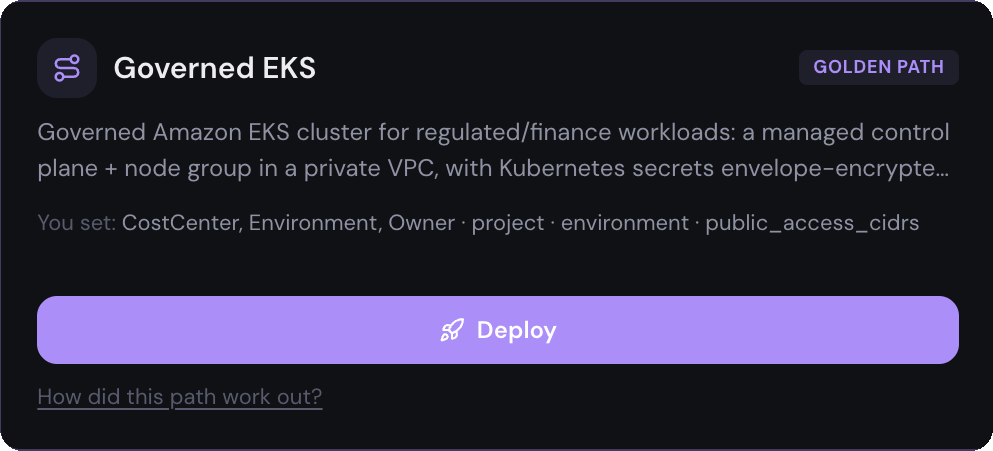
A published path deploys on its own. What could break production waits for a person.
What runs on its own depends on where the code came from and what the change can break. Changes that are hard to undo, or that touch production, wait for a person. Anything unvetted is reviewed first, sandbox included, and a platform engineer or owner signs off. When more than one account matches, Archie asks instead of guessing — the account is the blast radius. It lands in your own account, under the developer's name, and they never hold a credential.
sandbox-eu or prod-eu?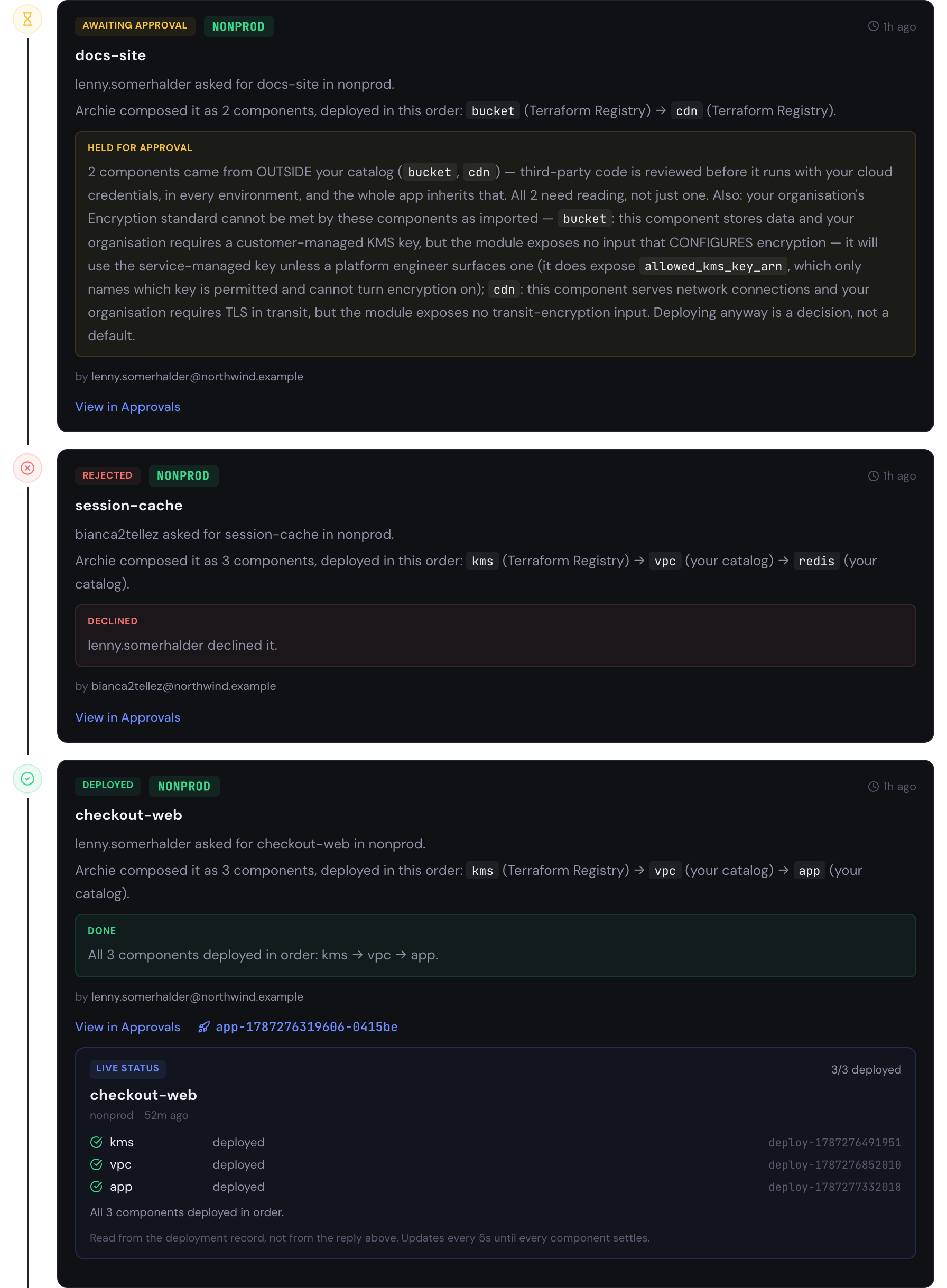
AWS, GCP, Azure and Kubernetes keys live in Archie, never in a session. The golden path is the only route to your cloud.
acct-… any more (AccessDenied on sts:AssumeRole). Nothing was deployed.One loop — and the catalog pulls the fleet forward.
Deploy, drift, remediate, upgrade, roll back, destroy — one loop, with a receipt and a Slack note. Publish v1.1 and every stack still on v1.0 shows outdated: a developer upgrades their own, or the owner rolls the whole fleet forward in one move. That's the difference between noticing change and governing it.
v1.1 is out — you're a version behindlog retention 30 → 7d. that field is locked.v1.1 · drift corrected · receipt + Slack sent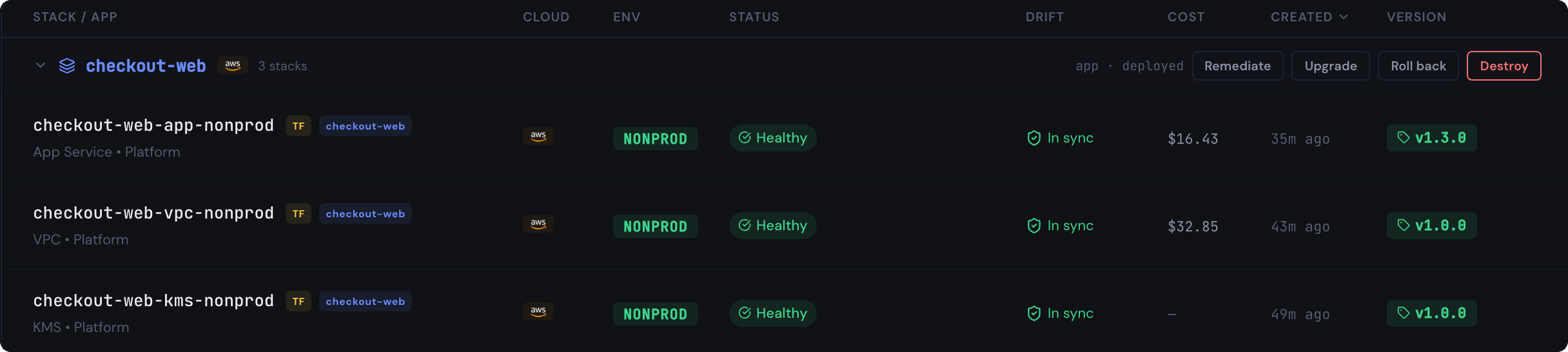
- Strongest from a clean start — and bring the Terraform you already have under governance.
- Read your existing Terraform state — see what it holds before anything is adopted.
- Drift flagged by severity, with fixes applied on approval.
Archie is built by Greg Lazarus — a Solutions Architect who got tired of hand-coding the same infrastructure for every project, and watching developers deploy without guardrails. No VC. Tested the only way that counts: a harness that deploys and destroys real infrastructure on AWS, Azure and GCP, and 52 test scenarios an agent runs as a customer — MCP and UI only, no source, no fixing the product mid-run. Thinking out loud about where this goes: Rethink DevOps — one real ticket an episode, run on a real cloud account and destroyed on camera.
The tools act. The UI reviews and controls.
Both roles ask in plain language — what differs is the toolset each is handed, and what they're allowed to change.
Compose, govern, deploy, operate.
Plain-language asks over MCP, from any agent. Platform engineers get tools to compose and govern golden paths; developers get tools to deploy and operate them. Different tools per role — one governed floor.
Watch, confirm, approve, audit.
The UI doesn't do the work — it's where you watch the agent's trace, confirm the plan, approve what's flagged, and read the audit. The how, the what, and the why of every action.
The rest of the platform, same rules.
Drift, cost, audit, multi-cloud — governed the same way the path was.
Drift detection
The live scan compares real cloud state to the governed state and flags drift, with remediation by severity.
Audit trail + Slack
Every action logged and explained — who ran it, what changed, why. Notifications on deploys, drift, approvals.
Cost at the deploy moment
Estimated spend shown when you deploy — per resource and per stack, not next month's bill.
Multi-cloud, multi-engine
Governs any spec — cloud or cluster, Terraform or Pulumi, in one workflow.
A platform team and ten tools — or one product you ask.
The internal developer platform was the big-org answer: a dedicated team stitching a stack of tools. Archie is its agentic evolution — the same governed self-service, as one product.
- Platform team
- IaC tooling
- CI/CD
- Policy engine
- Approval workflows
- Drift detection
- Developer portal
- Audit systems
Archie is the governed control plane for agentic infrastructure: bring any agent for interactive work, and Archie's governed automation is built to take on the reactive toil, with a receipt for every action.
It runs in your account.
Archie deploys inside your own cloud account — your credentials and state never leave it.
Self-hosted
recommendedSign in with your existing SSO; we never hold a credential.
- Your Git repo, your IaC engine
- Credentials never leave your VPC
- Your encryption keys, your state
Managed
by invitationFor design partners, we host a managed instance so you can explore the full platform before you stand one up in your own account. Ask us for an invite.
- Nothing to install
- Always on the latest version
- Move to self-hosted anytime
“What happens if we stop using Archie?”
Nothing. Your infrastructure runs in your cloud account; your state and IaC stay in your own bucket and Git repo, in the engine you deployed with. Cancel Archie and run your IaC directly — you lose the governance, the catalog and the drift detection, but your infrastructure is untouched.
We don't hold anything hostage. We earn your business every month.
Design partner pilot: free, 4–6 weeks.
Bring one golden path. We run it with you, governed, in your own account.
Start with a scan.
Week one, Archie scans your account (what's running, what it costs, what's ungoverned) and we plan your golden path against it together. Nothing is applied until you approve it.
What you get
- A findings report on what's running, and which changes your agents could make today unchecked
- One governed golden path in your account, which you keep
- Direct influence on the roadmap
- A named or anonymous reference, your choice
What we ask
- One workflow
- One person with cloud access
- Two or three short sessions
- Honest feedback
AskArchie is in pilot stage: an MVP+, built by one person, not yet in anyone's production.
Start with one repo.
We stand up Archie in your own account, compose one golden path from your existing infrastructure, and show you the whole loop end to end — self-hosted, your keys.